Blog
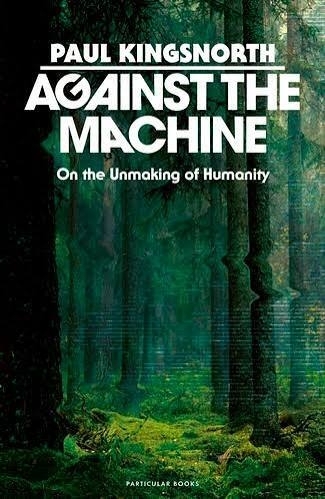
Rootlessness is the great disease A review of “Against the Machine” by Paul Kingsnorth Part One
Thursday 16th July 2026
Mike Mullins
Do you ever have moments when you see a film, read a book, or poem that captures your experience of life and it unlocks all it’s confused complexity and ambiguity? Suddenly the fog lifts, there’s clarity and you can see the refuge of the shoreline from your pilgrim boat.
I had that epiphany moment at the beginning of the year when I read Paul Kingsnorth book “Against the Machine”. This profound and disturbing book captured for me what we’re currently experiencing across society.
So, what is the “Machine”? The symptoms of Kingsnorth’s “Machine" are not just technological they are cultural and spiritual. A society dominated by the “Machine” becomes obsessed with efficiency, growth, consumption and control, while becoming increasingly disconnected from nature, place, tradition and community. People experience rising loneliness, anxiety and alienation, relationships become more transactional, the natural world is treated as a resource to exploit and human worth is measured by productivity and data rather than wisdom, character or belonging. In Kingsnorth's view, these are signs of a civilisation that has forgotten what it means to be fully human and fully alive.
In this book review I’ve tried to set out the main themes of “Against the Machine” and my reactions to it. I would urge you to read the book for yourself and decide whether it speaks to you about the many crises we face as a society. I’ve broken the review into two separate blogs that I’ll publish in July and then August because I found there was so much to say.
Kingsnorth’s book only hints at solutions. Following my two blogs exploring “Against the Machine” In September I’ll be posting a third blog based on interviews I’ve recently conducted with community faith leaders about how they are trying to combat the negative effects of the machine in their communities: Maitrinara a leader of the Brixton Triratna Buddhist Community in South London, Reverend Jonathan Herbert of the Franciscan Community at Hilfield, Dorset and Paul Wenham, leader of the Ashburnham, Christian retreat centre in Sussex. Inspiring and moving I found these encounters with Maitrinara, Jonathan and Paul to be tremendously hopeful and exciting – a glimpse of what the future could look like, where we combat the pernicious effects of the machine on human flourishing by building community belonging, rootedness and culture from the bottom up.
In his book Kingsnorth doesn’t make a political argument. He makes a civilisational and spiritual point. The book begins with a powerful reading of the Garden of Eden story in Genesis. The Fall is not about breaking God’s laws but humanity grasping power, knowledge and mastery before it has acquired the wisdom to wield them. The “Machine” as a mindset begins when knowledge becomes detached from wisdom.
For Kingsnorth the metaphor of the "Machine" is not merely computers, or AI, it is a civilisation built upon, control, efficiency, scale, growth, measurement and abstraction. It turns forests into timber, rivers into resources, people into consumers, cultures into markets. Living realities into units that can be measured and managed. Societies cannot exist without a shared sacred framework. Christianity once provided the west's moral and spiritual architecture. This sacred order gave meaning, limits and obligations. When that order was dismantled, a vacuum emerged. "If you knock out the pillars of a sacred order, the universe itself will change shape." Kingsnorth’s point, much like Nietzsche’s back in the late 19th century, with his declaration of the “death of God”, is not simply that Christianity was true but that every civilisation requires a deeper story about what reality is and what humans are for. Without such a story, culture loses its centre and crumbles.
For Kingsnorth modern societies condemn many traditional sins while celebrating endless consumption, acquisition, competition and economic growth . “Now our economy runs on greed.” The result is an economy that treats desire as sacred. The market has become the new god.
Rootlessness though is the great disease. Humans need place, ancestry, community, tradition and belonging . Kingsnorth cites French philosopher, Simone Weil, who argued human beings need roots. Yet the machine excels at uprooting people from their indigenous, local culture, their landscape, family, continuity and inherited sacred meaning. The result is our alienation.
Culture is organic not manufactured. It’s like a forest, or a meadow, it emerges over centuries, it develops from place and arises from shared memory. It’s not a government project, a branding exercise, or an ideology but something living. When it’s uprooted and replaced by abstractions, it dies.
The machine’s “quest for perfection is a quest for homogeneity and control." Kingsnorth has no time for utopian thinking, whether communist, fascist, technocratic (Elon Musk and the “tech bros” ) and neoliberalism, all share a dream of perfecting society. Human beings are messy, living cultures are messy. Attempts to impose perfection led to bureaucracy, coercion, conformity and ultimately violence. Think of communist gulags, Maoist collectivisation and Nazis concentration camps.
A refrain I totally agree with is that the ecological crisis is a spiritual crisis. Environmental collapse is a symptom rather than the root problem. The deeper problem is our separation from nature, worship of growth, rejection of limits, loss of sacred relationship. We destroy the Earth because we no longer know how to belong to it. Here I would argue with Kingsnorth and say that the root problem is our arrogant belief that we sit atop some illusionary evolutionary hierarchy. At one time we were just below God and the angels but now in our atheistic age, we sit supreme at the top.
The old gods have been replaced, not by atheism but by the autonomous self, personal choice, and individual desire. "We have become slaves to the power of money and worshippers of the self." The modern individual is presented as free. Yet the opposite is true the detached, isolated, individual becomes easier for the “Machine” to manipulate. People sense something is wrong. I know I have for many years felt ill at ease with our culture and in particular where corporates are heading. There is political polarisation, identity conflicts, anxiety, loneliness, loss of meaning, nostalgia and cultural fragmentation. These are not isolated problems. They arise according to Kingsnorth because a civilisation has lost confidence in its own story.
Kingsnorth cites the Christian, French philosopher and resistance fighter Jacque Ellul as an interpreter of the “Machine”. The problem is not technology itself It is what he calls technique, meaning efficiency as the highest value, measurement over meaning, optimisation over wisdom, control over participation, systems replacing judgement. Look at modern corporate leadership and how it has lost touch with character and virtue. Today leadership is about risk and reputation management. The Post Office scandal and Grenfell Tower tragedy are primary examples. Technology is simply the tool; technique is the mindset. The “Machine” is not just technology, computers and factories, it is a way of seeing. For Ellul technique eventually destroys whatever slows it down, nature, tradition, religion, custom and local culture
"Technique takes aim at and will ultimately destroy the traditional foundations of human life, nature, culture and religion."
The Machine cannot tolerate limits. Anything that cannot be quantified or optimised becomes an obstacle. In the industrial era we used machines. In the age of technique, machines begin using us: data collection, surveillance, behavioural management, algorithmic control. People are increasingly becoming objects to be measured and manipulated. Man is overpowered by technique and becomes its object. You are harvest.
The Machine does not survive because it is evil but because it works. It gives us convenience, comfort, speed, abundance and entertainment. As my good friend, organisational development consultant, writer and poet, Tim Richardson says “we are being convenienced to death”. People embrace it because it solves genuine problems. The danger is that every solution expands its reach.
Modern control rarely appears as overt tyranny. Instead, it is convenience, safety, efficiency and optimisation. The more our lives are mediated by systems, the fewer routes of escape remain. Control becomes subtle rather than visible.
The defining conflict of our age is not left versus right, capitalism versus socialism or conservative versus progressive but the living world versus the technological system. It is life versus the “Machine”.
Join me in August for part two and later in September for an exciting and hopeful blog on ways we can become humble warriors against the machine.